
Solar Brands Compared: The Top 5 Panels, Inverters, and Batteries in the Philippines (2026)
Shopping for solar and drowning in brand names? This guide lays out the five most common brands for each part of a solar setup, in plain terms. What they cost, what their warranty covers, and the honest catch with each one. We don't sell any of them, so no brand gets crowned the winner. You pick what fits your home and budget.
Published July 24, 2026 by C
The 30-second version
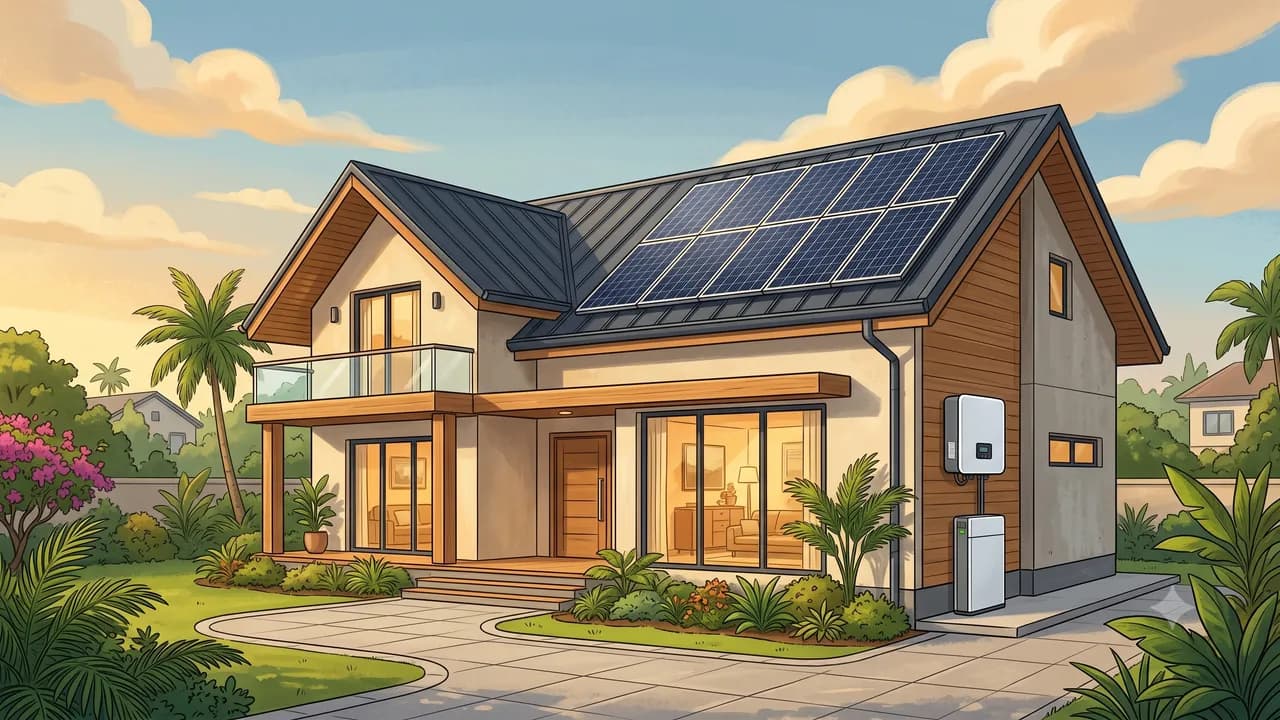
A solar setup has three parts:
- Panels on your roof catch the sunlight.
- The inverter is the box that turns that sunlight into power your house can use. Think of it as the brain.
- The battery stores extra power for brownouts and nighttime. This one is optional.
Panels last the longest and rarely break. The inverter is the part you'll most likely replace once during the system's life. The battery is the priciest part, and you only need it if you want backup power during outages.
Two quick things to know before the tables:
"Tier 1" does not mean better quality. It only means big banks trust the brand enough to finance projects with it, so the company is likely to still be around in 20 years to honor your warranty. That's useful, but it is not proof the panel is good. Ignore anyone who sells "Tier 1" as a quality badge.
The prices here are estimates, not quotes. They change with the supplier, the season, and where you live. Use them to get a rough idea, then ask at least three installers for real quotes.
Panels: what catches the sun
All five brands below are solid, and honestly, the differences between them are small. Two tips that matter more than the brand:
- Ask for panels made for heat. The current standard is called N-Type TOPCon, a newer panel type that holds up better in Philippine sun. If a 2026 quote offers older "polycrystalline" panels, that's likely old stock. Ask why.
- A panel has two warranties, not one. The performance warranty (often 30 years) promises the panel will still make about 87–88% of its power late in life. The product warranty is shorter and covers the panel physically breaking. Sellers love to quote the big 30-year number. Always ask for both, for your exact panel model.
Brand | Warranty | What's good | What to watch |
|---|---|---|---|
Jinko (Tiger Neo) | Output: ~30 yrs. Defects: often 15 yrs | Best in heat, very efficient, so you need fewer panels | Defect warranty changes by country. Ask for the PH number |
LONGi (Hi-MO) | Output: ~25–30 yrs. Defects: 12 yrs on the basic model | World's biggest maker, proven, easy to find | Defect warranty shorter than it sounds |
Canadian Solar | Output: 30 yrs. Defects: 12 yrs (some sellers say 25) | Good reputation for actually paying out claims | Sellers quote different defect years. Get it in writing |
JA Solar | Output: ~25 yrs | Cheapest of the trusted brands | Fewer heat-handling extras than Jinko |
Trina | Output: ~25 yrs | Strong in very hot spots | Less common on PH homes than Jinko or LONGi |
One panel costs roughly ₱6,500–₱13,000 before installation.
Inverters: the brain of the system
The inverter is the part most likely to need replacing someday. Panels last 25–30 years. Inverters usually last 10–15, with warranties of 5–10 years. Because it's the part you may replace, local support matters more than a fancy spec sheet. A brand with a service center near you beats a famous brand with no parts in the country.
One choice comes before the brand: string or hybrid?
- A string inverter is cheaper but cannot connect to a battery.
- A hybrid inverter can connect to a battery later.
If there's any chance you'll want backup power in the next five years, get a hybrid now. Adding it later costs more.
Brand | Warranty | What's good | What to watch | Best for |
|---|---|---|---|---|
Growatt | 5–10 yrs | Cheapest reliable pick (~₱36k–54k for a 5kW hybrid), easy phone monitoring | Budget build, shorter warranty | Smallest budget, fastest savings |
Deye | 5–10 yrs | The go-to for homes that want a battery, works with many battery brands | Costs more (~₱76k–114k for 5kW hybrid) | Homes planning to add a battery |
Solis | 5–10 yrs | Works with almost any battery brand | Fewer premium features | Mixing brands, flexibility |
Sungrow | 10 yrs (can extend to 25) | Very trusted, pairs with most batteries | Warranty shrinks near the sea: cut to 2 yrs within 2–5 km of the coast, and voided within 2 km | Trusted pick, inland homes |
Huawei | 10 yrs | Best monitoring, extra fire-safety features, sleek design | Expensive, locks you into its own system | Buyers who want top monitoring |
The honest take for most homes: the mid-priced brands (Deye, Solis, Sungrow) perform about as well as the expensive ones for half the price. The premium brands mainly earn their cost on fancy monitoring, not bigger savings.
Batteries: your backup for brownouts
A battery keeps your lights and fans running when Meralco goes down. It's the most expensive part, and you do not need it to save money on your bill. Get one only if backup power during outages matters to you.
All five below use the same battery type, LiFePO4, which handles the heat of a Philippine roof well and lasts for thousands of charges. When you compare batteries, check three numbers, not one: how many years, how many charges (aim for 6,000 or more), and how much capacity is guaranteed to be left at the end. Prices are for a roughly 5kWh unit, battery only.
Brand | Warranty | What's good | What to watch |
|---|---|---|---|
Pylontech | 7 yrs, or 10 if you register it online after install | Widely seen as the most reliable for PH homes, works great with Deye and Growatt | You lose 3 warranty years if you forget to register |
BYD | ~10 yrs | World's biggest battery maker, best service coverage nationwide | Priciest of the group |
Deye | ~10 yrs | Pairs perfectly with a Deye inverter, one app for everything | Best value only if you already use a Deye inverter |
Dyness | 10 yrs | Handles heavy loads like aircon well | Newer brand, shorter track record here |
Soltux | Varies, confirm | Cheapest way into having a battery | Warranty terms less consistent, check carefully |
The money tip most quotes skip: match your inverter and battery
Here's a simple trick. If your inverter and battery are the same brand (a Deye inverter with a Deye battery, for example), they work together smoothly: one app, one system, and often one combined warranty.
Mix two brands and it usually still works, but you might need an extra connector box, lose some control over the battery, and even cancel part of both warranties. It's like sticking to one phone brand for your charger and accessories. Mixing is possible, matching is simpler.
What a full setup costs, and when it pays for itself
A complete on-grid system usually costs around ₱55,000–₱75,000 for every 1 kW installed. That covers the panels, inverter, mounting, wiring, permits, and the net-metering paperwork. So a 5 kW system, a good fit for a medium home with two or three aircons, runs about ₱250,000–₱400,000. Adding a battery costs ₱50,000 or more on top.
When does it pay for itself? A recent study by Ember found that a grid-tied home system pays back in about 3.1 years as of May 2026, faster than the 4 years it took a year earlier, because Meralco rates went up and equipment got cheaper. Your own timeline depends on your bill. A big Meralco bill pays off faster. A smaller bill, or adding a battery, can stretch it to five or more years. After that, the system keeps saving you money for the rest of its 25-year-plus life.
Your quick checklist before you buy
- Pick a trusted panel brand and get both warranty numbers, defects and output, for your exact model in writing.
- String or hybrid? If a battery is in your future, buy a hybrid inverter now.
- Match your battery to your inverter brand when you can, for one app and one warranty.
- Make sure the quote is complete: panels, inverter, mounting, wiring, permits, net-metering, and setup.
- Check for local service, and if you live near the sea, read the inverter's coastal warranty rule.
- Get at least three quotes. Service quality differs more than the hardware does, and the cheapest quote is rarely the best deal.
We don't sell any of this and we don't favor any brand or installer. We just want you comparing them clearly. Follow the blog for more plain-English guides before you buy.
Note on figures: Prices are 2026 Philippine market estimates, shown as typical ranges, not quotes. Get at least three current installer quotes before deciding. Reliability notes reflect what installers and buyers report, not lab tests, and are not endorsements of any brand. Warranty details are the manufacturers' stated terms, honored locally through each brand's PH distributor. Confirm them for your exact model and location. The Tier-1 bankability list (BloombergNEF) and the 3.1-year payback figure (Ember, May 2026) come from independent sources.
Stay updated on PH solar
Get new guides, updated cost data, and free tool alerts - straight to your inbox.
Already ready to compare installers?
We use the details you submit only to follow up with installer options. See our Privacy Policy.