
An Installer Wants to Add Optimizers to Your Quote. Read This First.
Somewhere in your solar quote, between the panels and the inverter, there may be a line that says "optimizers" — one small device per panel, each adding to the price. Ask why, and you'll usually get some version of "they make your panels perform better." That answer is true, false, or expensive nonsense depending entirely on your roof. Here's how to know which one you're hearing.
Published July 20, 2026 by C
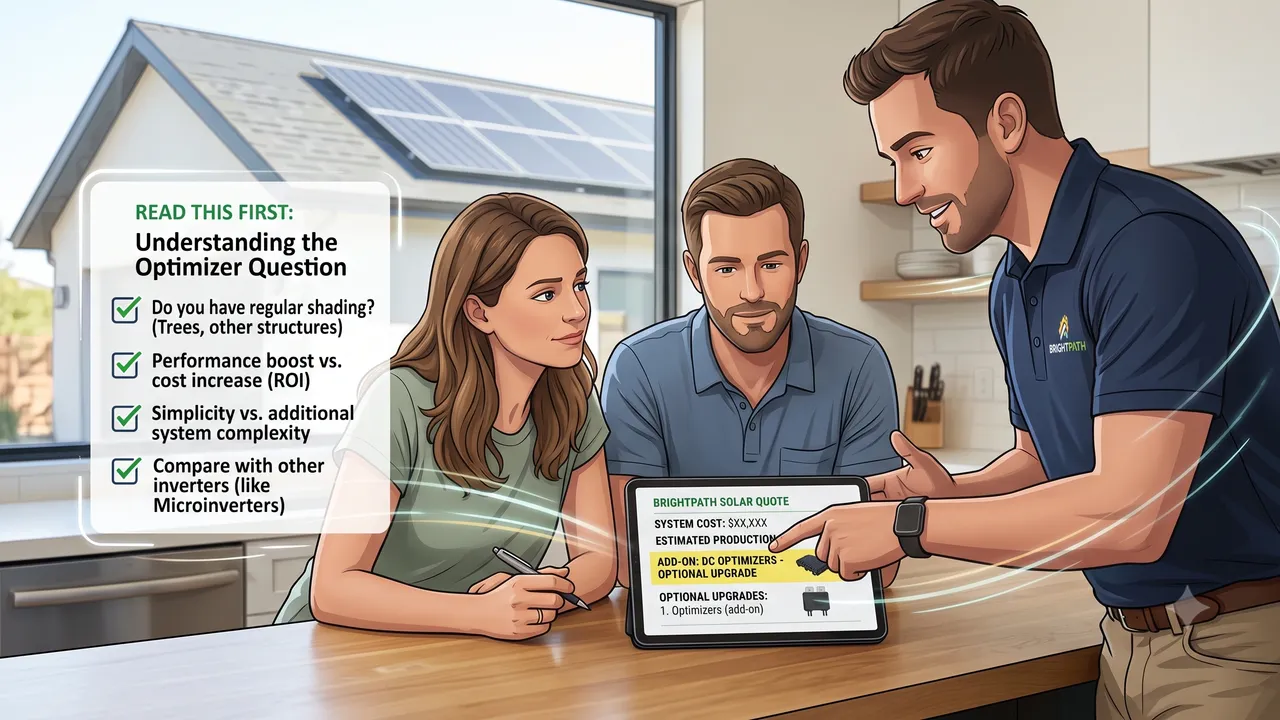
The problem optimizers exist to solve
In a standard installation, your panels are wired together in a series called a string, and the string feeds one central inverter. Wiring in series is cheap and reliable, but it has a known weakness: the string tends to perform like its weakest panel. When a water tank's shadow crosses two panels at 3 p.m., the whole string can sag with them, not just those two.
Modern panels soften this with built-in bypass diodes, which let power route around a shaded section. Real shade still hurts, but the old sales line that "one leaf can shut down your whole roof" oversells the problem. Keep that in mind when the pitch gets dramatic.
An optimizer attacks the weakness directly. It's a small electronics unit mounted under each panel that manages that panel individually, so a struggling panel no longer drags down its neighbors. Each panel does its best on its own, and the inverter collects the total. As a bonus, most optimizer systems report per-panel data to an app, so you can see exactly which panel is underperforming and when. If you read our piece on spotting a sick system, you'll recognize how useful that is.
When they earn their cost
Optimizers are relevant in rough proportion to how complicated your roof is:
Shade that moves. A neighbor's mango tree, a water tank, an extension next door, a nearby building that shadows part of your array in the afternoon. If some panels regularly sit in shade while others sit in sun, per-panel management pays for itself in recovered output. This is common in dense subdivisions and urban lots, where roofs rarely get open sky all day.
More than one roof face. Many Filipino homes have hip roofs, so an array often ends up split across faces pointing different directions. Panels facing east and panels facing west peak at different hours, and panels managed individually handle that mismatch better than one string pretending everyone faces the same way.
Shade that's coming. Trees grow. If the shade situation will be worse in five years, wiring for it now is cheaper than rewiring later.
You want per-panel visibility. On a plain string system, a single failing panel hides inside the string's total. Per-panel monitoring turns "production seems low" into "panel 7 died in March."
When they're an upsell
If your roof is a single unshaded face pointing one direction — no trees, no tanks, no taller neighbors, none planned — a well-designed string system already performs close to its potential, and optimizers add cost without much to optimize. They also add one more piece of electronics per panel, sitting on a hot roof for decades. Every added component is another thing that can eventually fail, and replacing one means someone going back up there. Simple roofs deserve simple systems.
A note on the alternative you may also be quoted: microinverters do the panel-level job a different way, converting power at each panel and skipping the central inverter entirely. The same logic applies. Complicated roof, panel-level electronics start making sense; simple roof, simpler system.
The three questions that settle it
You don't need to become an engineer. You need three questions:
- "Show me the shade analysis." A serious installer assesses your actual roof (sun path, obstructions, seasons) before recommending panel-level hardware. If the recommendation came before anyone studied your shading, it came from a price list, not your roof.
- "Quote it as a separate line item." You want to see what the optimizers cost on their own, so you can judge the upgrade against the problem it solves. Bundled pricing hides that math.
- "Who replaces one when it fails, and under what warranty?" Panel-level devices carry their own warranty terms, separate from the panels and the inverter. Get the answer in writing, including who pays for the roof visit.
An installer with good answers to all three is telling you something about how they'll treat you after handover. An installer who bristles at them is telling you something too.
We don't sell solar and we don't take sides between installers — we'd just rather you buy the system your roof actually needs. Follow the blog for more of the questions worth asking before you sign.
Note on figures: This piece is deliberately free of peso costs and performance percentages. Optimizer pricing varies by brand and system size, and recovery claims in vendor marketing are measured under conditions your roof may not share. When we have verified Philippine pricing data, we'll publish it.
Stay updated on PH solar
Get new guides, updated cost data, and free tool alerts - straight to your inbox.
Already ready to compare installers?
We use the details you submit only to follow up with installer options. See our Privacy Policy.